|

|
|
This entry has three pages:
|
|
|
|
Architecture
|
|

[Click for a larger image]
|

t came to pass the middle of the third age
Durin was again its king, being the sixth of that
name. The power of Sauron, servant of Morgoth, was then again
growing in the world, though the Shadow of the Forest that looked
towards Moria was not yet know for what it was. All evil things were
stirring. The Dwarves delved deep at that time, seeking beneath
Barazimbar for mithril, the metal beyond price that was becoming
yearly ever harder to win. Thus they roused from sleep a thing of
terror that, flying from Thangorodrim, had lain hidden at the
foundations of the earth since the coming of the Host of the West: a
Balrog of Morgoth."
|
J.R.R.T,Lord of the Rings, Appendix A: III "Durins Folk"

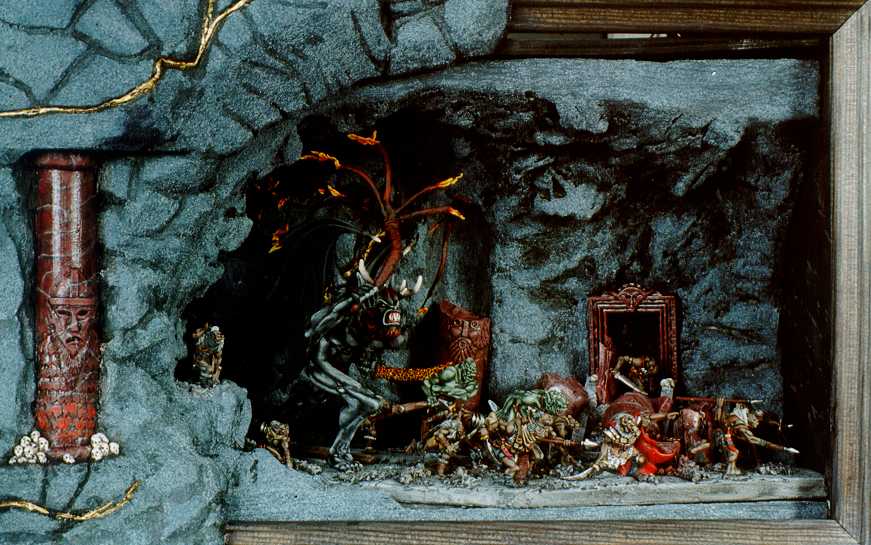
This scene, or shadowbox as is the case (no pun intended), is the hereto largest I have made, both in size and number of
miniatures used. It shows the Balrog of Moria, Durin's
Bane, herding a horde of orcs and trolls along an
underground road in the ruined remains of the once
great dwarf hold. The scene is not intended to represent
any particular event in the Lord of the Rings. I felt it
should be up to the spectator to decide. Perhaps the cruel
Valaraukar is driving his minions towards the Chamber of
Mazarbul, where the Fellowship has been spotted...?
Normally I just put the scenes behind glass in a box but
this time I did things a little different. Instead of
letting the whole cavern be contained within the shadowbox
I let the scene continue 'though' the glass cover and stick
out on the left side of the box. I had a couple of reasons
for doing this way. First of all breaking conventions, even
small, seemingly insignificant ones like this, attracts attention.
Secondly I wanted the scene to look like it really was a cavern
deep within the heavy rock of the Misty Mountains. Since I wanted
the scene to be crammed on the inside with miniatures
(one quite huge one to!), I knew there would not be a lot of
space for making a bulky rock face and a thin veneer like one
would look really silly. The obvious solution was to put it on
the outside instead. Normally I do most of the groundwork on a
base of styrofoam since it is lightweight and with the right
tools very easy to shape. I used it on the inside of the scene
in the conventional way but since styrofoam will dent easily if
bumped into so I knew I would have to go with
something sturdier for the outside bits. These were therefore
made by blocks of balsa wood which were glued to the frame of
the cover to the shadowbox and later carved into shape with a
sharp knife. (Balsa wood always needs to be cut with a sharp
blade or it will get sort of frayed at the cuts.) Everything
was then covered with a generous amount of spackling.
At this dept under Redhorn, Cloudyhead and Silvertine
(the three peaks above Moria) I figured the rock would
be basalt so I sprayed everything with satin black a
few times. This turned out a little glossy but that
was OK, since there is bound to be quite a lot of
moisture this far down and the rock face was going
to be partially coated with a matter paint later. This
particular paint was a new experience for me: a black
granite imitation paint. It contains fine differently
colored grains to simulate rock texture and color shifts.
When I first applied it I was quite happy with the result
but later when miniatures and details started to get into
place I realized the granite effect did not work very
well in scale. The grain in the paint was a little bit
too coarse and reminded me more of sandstone. Oh, well…
We live and we learn. Besides, the result was not devastating.
After a few coats of the textured paint I applied a black wash
to the cracks and recesses and a little highlights to the
outcrops. As a final touch I rolled out thin coils of epoxy
putty, applied them to some of the cracks and painted them
in dull gold to simulate veins of ore and minerals. This
broke the grey surface of the rock in a few places and made
it a little more interesting. These veins do not represent
mithril, by the way. Every load of true-silver but those in
the deepest mines had been depleted by the time the balrog chased
the dwarves out of Moria.
The pictures to the left shows a cut out and close up of the
dwarven pillar on the piece that protrudes from the box; the
glass cover is really behind this piece and before where the
orch archer is standing. Just like the rest of the dwarf made
architectural details in this hall, I chose to paint and model
it as if it was made of polished, veined red granite,
scarred by abuse and age. The orc infesting Moria were
likely to have defiled all dwarven relics in the deep halls,  pretty much the same way as the Gondorian Royal Statue in
Ithilen are described in LotR, The Two Towers, 'Journey to
the Cross-Roads':
pretty much the same way as the Gondorian Royal Statue in
Ithilen are described in LotR, The Two Towers, 'Journey to
the Cross-Roads':
"The years had gnawed it, and violent
hands had maimed it. Its head was gone, and in its place was
set in mockery a round rough-hewn stone, rudely painted with
savage hands in the likeness of a grinning face with one large
red eye in the midst of its forehead. Upon its knees and mighty
chair, and all about the pedestal, were idle scrawls mixed with
the foul symbols the maggot-folk of Mordor used."
As you can see
I was quite inspired by this text. At the base of the pillar skulls
of fallen dwarves are stacked (all individually sculpted from Miliput).
Like the King's throne and in true orcish tradition, orch glyphs and
obscenities sully the scale mail of the carved representation of a dwarf
lord. To the right you can see some of the sketches I drew for the orc glyphs.
To the right you can see some other objects representing
ruined specimen of dwarven architecture. The doorway is
M286 from Mithril's 'Chamber of Mazarbul' series, the other
two are scratch built from wood and epoxy putty. I wanted
the architecture to look as coherent and thematic as possible
so did some thorough research on dwarven art and craft. The most
obvious bit to consider was of course the west gate of Moria,
which is one of the few drawings in the LotR (see drawing to the left below).
Though the inlays in the magical metal ithildin without doubt were
made by a dwarf called Narvi, I felt they were a bit too swirly to
fit my impression of the dwarven art in the deep halls. I decided
to attribute this to the fact that the west gate was the result of a
joint venture between the Noldo smiths of Eregion under Celebrimbor
and the dwarves. The words that can be seen in the West Gate drawing
are written in Tengwar, an elven script dwarves did not use among themselves.
 Instead they used a script called Angerthas, also an elven invention but
which was from the mid Second Age learned, adapted and loved by the
dwarves to the degree it eventually became called Angerthas Moria and
finally Dwarf-Runes. It was more angular and suitable to be cut in rock
and dwarves used it enthusiastically to decorate their halls. The tomb of
Balin, which is mentioned in the LotR, was inscribed with Angerthas runes
(see picture to the right). It is also said that the East Gate of Moria was much
less friendly than the West Gate since it had runic script in many languages
that spoke forbidding words to those who approached the gates without the
leave of the King of Moria. Chris Tubb at Mithril has obviously had a little fun when
sculpting the portal, because it has nearly microscopical inscriptions in
Angerthas runes down both sides which spells out as follows:
Instead they used a script called Angerthas, also an elven invention but
which was from the mid Second Age learned, adapted and loved by the
dwarves to the degree it eventually became called Angerthas Moria and
finally Dwarf-Runes. It was more angular and suitable to be cut in rock
and dwarves used it enthusiastically to decorate their halls. The tomb of
Balin, which is mentioned in the LotR, was inscribed with Angerthas runes
(see picture to the right). It is also said that the East Gate of Moria was much
less friendly than the West Gate since it had runic script in many languages
that spoke forbidding words to those who approached the gates without the
leave of the King of Moria. Chris Tubb at Mithril has obviously had a little fun when
sculpting the portal, because it has nearly microscopical inscriptions in
Angerthas runes down both sides which spells out as follows:

If anyone is able to decipher and translate them for me there is a
small price to win! Beside the runes, it is also said that dwarves forged beastly masks and other stern and grotesque representations.
Chris Tubb has used strong but simple designs for the portal so it
would work well for the rest to.
 With this in mind I made a few sketches of
carvings and masks and ended up with two I wanted to use as carved image of a dwarf
lords on the pillars. The left intact pillar supporting the arched roof
under which the Balrog passes can be seen above. To the left is the sketch which resulted in the
image one the broken pillar in the photograph (above right).
Symbolically enough the top part of the pillar has been broken
of, thus bereaving the lord of his crown-like helm (Oooh!). This crowned helm
was by the way inspired by Durin's crown in the illustration of the
West Gate. A little note on making large shadowboxes: as you can see
most parts in this scene can be taken out and fitted in again. This is
something I really recommend. Try to build separate manageable pieces
that fit into slots in the scenes. It is much simpler than it sounds and
can save you a lot of trouble as you proceed with your work. Even when you
think a miniature is ready to put it in its place you will ever so often later
find out that something is missing, needs to be repositioned or touched up. By
then you can create some real damage to the whole scene by trying to pry them loose.
Trust me, I have been there.
With this in mind I made a few sketches of
carvings and masks and ended up with two I wanted to use as carved image of a dwarf
lords on the pillars. The left intact pillar supporting the arched roof
under which the Balrog passes can be seen above. To the left is the sketch which resulted in the
image one the broken pillar in the photograph (above right).
Symbolically enough the top part of the pillar has been broken
of, thus bereaving the lord of his crown-like helm (Oooh!). This crowned helm
was by the way inspired by Durin's crown in the illustration of the
West Gate. A little note on making large shadowboxes: as you can see
most parts in this scene can be taken out and fitted in again. This is
something I really recommend. Try to build separate manageable pieces
that fit into slots in the scenes. It is much simpler than it sounds and
can save you a lot of trouble as you proceed with your work. Even when you
think a miniature is ready to put it in its place you will ever so often later
find out that something is missing, needs to be repositioned or touched up. By
then you can create some real damage to the whole scene by trying to pry them loose.
Trust me, I have been there.
To the left a shot showing the ramp minus the balrog.
To make the ramp detachable was pretty much a must for
the reasons mentioned above. It didn't help much though,
and I'll tell you why: I almost ever cut the bases from my
miniatures but rather embed them in the groundwork. The
reason for this is mainly because white metal is soft
and I would be anxious to hurt details on them in the
process. Another (lesser) reason is that I have few
doubles of these collector items that are now becoming
quite rare, especially the early series. Therefore I
like to keep them as intact as possible, should I want
to use one in another context. They way I went about
in this case was like this: I cut the ramp into its
shape and covered it in an even layer of acrylic
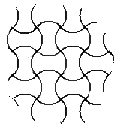
spackling. When it was still soft but not sticky I traced
an axe head flagstone pattern (see the sketch to the right)
into it and let it dry.
 Afterwards I scratched cracks in
them and broke out shards from them to make them look broken
and worn. Then I ruined it all by tracing an outline around
the base of each miniature where I wanted them to stand on
the ramp. These outlines were milled out to the dept of the
bases of each miniature, which were then placed in the
depressions and their bases smoothed over with spackling.
I traced the axe head pattern again (tricky, that) and
painted the paving in appropriate colors. Now it was time
for the rubble: the broken top of the pillar was positioned
and assorted debris sprinkled over the neglected causeway.
Gluing and painting this among all the nicely painted miniature
proved to be a real hassle. Even though I had varnished them good
I had go back and touch them up several times. The balrog proved to
be the least trouble to position since it is not cast onto its base.
I just pinned it on the road when I was done with it. There is one
thing, …well, two to be honest… about the causeway I wish I had done
differently: I) I should have made it slope slightly from its furthest
point and forward. This would have given the scene a better sense of
direction and speed; II) I should have given the side of the causeway
a little more attention. From the side it looks like it is made from one
big lump of rock rather than a lot of flagstones.
Afterwards I scratched cracks in
them and broke out shards from them to make them look broken
and worn. Then I ruined it all by tracing an outline around
the base of each miniature where I wanted them to stand on
the ramp. These outlines were milled out to the dept of the
bases of each miniature, which were then placed in the
depressions and their bases smoothed over with spackling.
I traced the axe head pattern again (tricky, that) and
painted the paving in appropriate colors. Now it was time
for the rubble: the broken top of the pillar was positioned
and assorted debris sprinkled over the neglected causeway.
Gluing and painting this among all the nicely painted miniature
proved to be a real hassle. Even though I had varnished them good
I had go back and touch them up several times. The balrog proved to
be the least trouble to position since it is not cast onto its base.
I just pinned it on the road when I was done with it. There is one
thing, …well, two to be honest… about the causeway I wish I had done
differently: I) I should have made it slope slightly from its furthest
point and forward. This would have given the scene a better sense of
direction and speed; II) I should have given the side of the causeway
a little more attention. From the side it looks like it is made from one
big lump of rock rather than a lot of flagstones.
Go to:
["Moria: The Orcs"]
["Moria: 'Durin's Bane'"]
Back to the top
Back to Scenes from Middle Earth
Peder Hammarskiold ph@shapingmiddleearth.com
Copyright Peder Hammarskiold 1999 All rights reserved.